Practice News
For info
From the 1st April 2026, the way we review our patients with long term conditions is changing. We will be using a system called Medlink. This system is integrated with your medical records and will be managed by our administration team and nursing team. We will continue to do an annual review in your birth month but instead of you having to contact us to arrange this, we will be contacting you through medlink with instructions of what the nexts steps are. You will be advised if you need any tests and you will be able to book these appointments via a link, you will also be sent a questionnaire to complete. Please ensure you complete the questionnaire to the best of your ability and in full and then return to the practice, again through the link provided. The nursing team will then contact you with any further actions required. We thank you in advance for your support with this new system that we feel will really help both the practice and the patients. We will be contacting any patients directly that are unable to use the link as we currently do
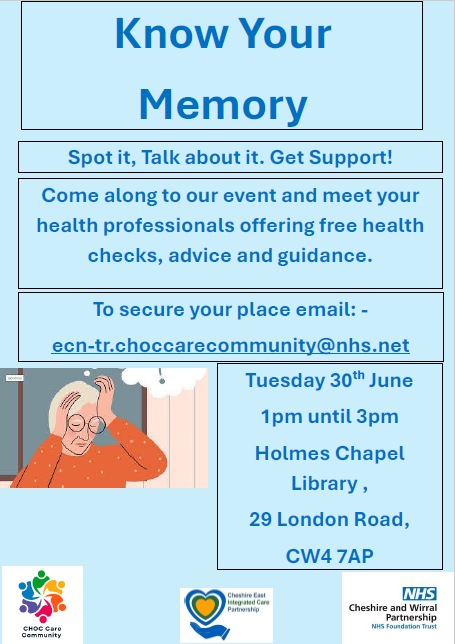
Know your memory event 30th June 2026
Mounjaro (Tirzepatide) prescribing in Cheshire and Merseyside
Changes to messaging from the Health Centre
The way you receive your text messages from Holmes Chapel Health Centre is changing.
Unfortunately, from the 1st April 2026, funding for text messages had been cutback by the Cheshire and Merseyside ICB across all practices in Cheshire and so we have looked into new ways of contacting our patients.
The NHS has asked practices to move to more digital and modern ways to practice and deliver healthcare. As part of this, practices have been encouraged to embrace more digital ways of communication including:
· Email communication
· Use of the NHS App
We are adopting the following methods in communicating with patients:
1. Initial contact by email
2. Contact via NHS App where email isn’t available
3. Contact by SMS where NHS App contact isn’t available
To help facilitate these plans for future communication we would ask all patients to consider the following:
Emails:
Ensure we have email contact details for you if relevant and be mindful that future messages will come via email.
If you have a shared email which may be on multiple patient accounts, consider making separate accounts.
NHS App:
Download the NHS App and ensuring that notification settings are turned on.
The NHS App has many useful functions besides receiving practice messages, including:
· Ability to access your medical record anywhere, at any time.
· You can order your prescriptions online, even when the practice is closed.
Please note if a message isn’t successfully delivered or read by you within 24 hours, our messaging provider will automatically send a ‘fallback’ message via another channel, such as SMS, to ensure you receive the message.
Mounjaro (Tirzepatide) prescribing in Cheshire and Merseyside
Medication for holidays and travelling abroad
Under current legislation the NHS ceases to have responsibility for the medical care of patients when they leave the UK.
For patients who inform us they will be out of the country for less than 3 months, the NHS will provide sufficient medicines from their repeat prescription to cover the period abroad. However, this is at the discretion of the GP. There is no obligation to prescribe in this situation, and medications may not be prescribed if they require frequent monitoring or if there are safety concerns. For periods longer than than 3 months, patients need to find an alternative supply of their medication.
GPs are not required by their terms of service to provide ‘just in case’ prescriptions for the treatment of a condition that is not present and may arise while the patient is abroad or as a result of travel. This includes:
- ‘just in case’ medications for treating travel related illnesses e.g. travel sickness, diarrhoea, and requests for medication due to travel abroad
- postponement of menstruation
- travel sickness
- treatment of jet lag
These situations are not covered by the NHS. The GP is not obliged to provide a prescription but if they feel it is clinically appropriate, and the medication can be self-administered safely without medical assessment, a private prescription may be issued at a cost of £20. This does not include the cost of the medication.
In line with prescribing guidance, the practice no longer issues prescriptions for fear of flying or to aid sleep during flights.
See the Prescriptions page for more information.
A message regarding collective action – ‘Protecting patients, protecting general practice’
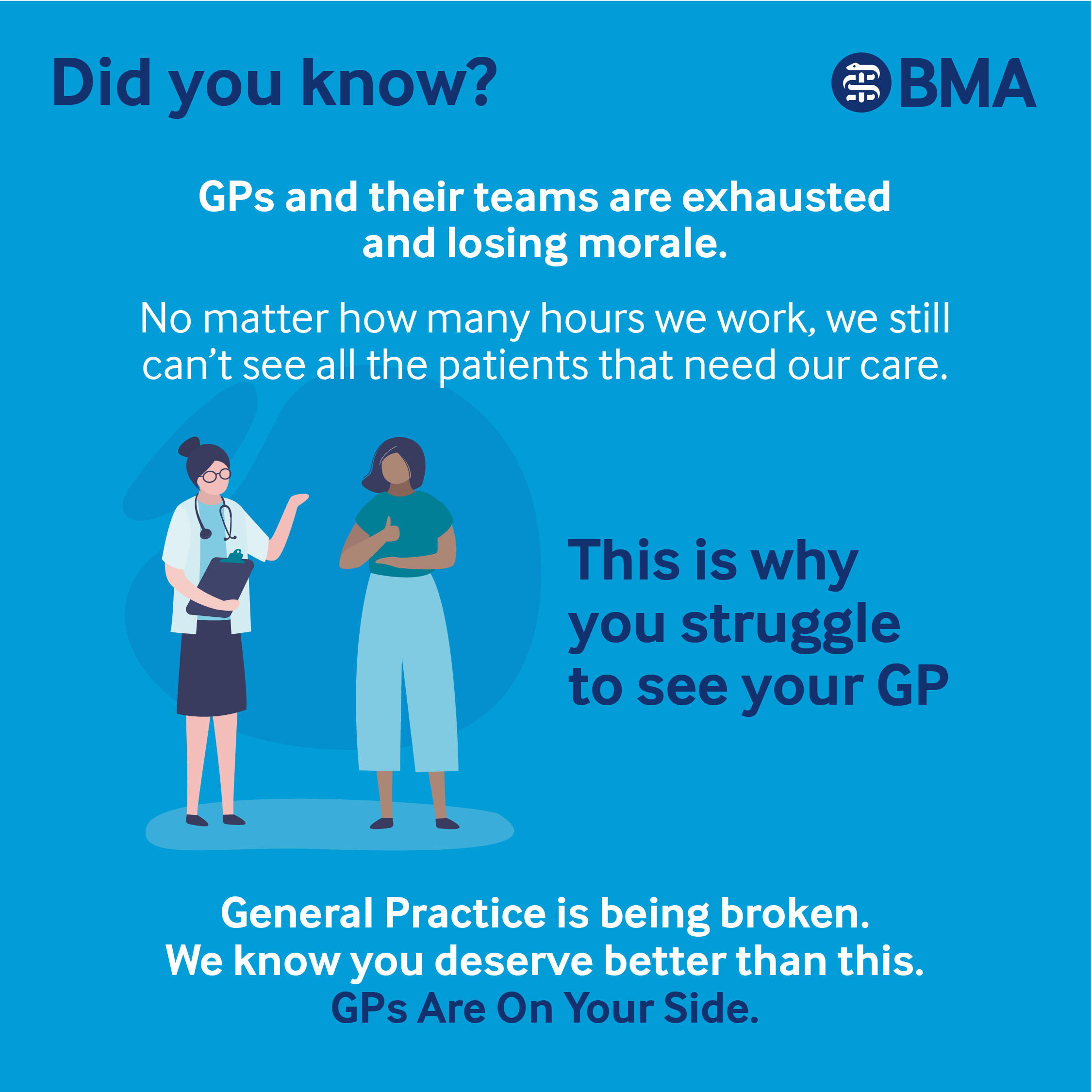 In March the British Medical Association (BMA) held a ballot asking GPs to support action against the erosion of funding for general practice that over the past few years has had a negative affect on patient care and staff morale.
- In the last 5 years GP practices have lost funding worth over £660 million.
- We're not allowed to use the poor funding we have to recruit more GPs or more practice nurses.
- GPs and our team are losing morale.
- No matter how many hours we work, we still can't see all the patients that need our care
The result of the ballot was an overwhelming ‘yes’ to taking action and as a direct consequence all practices in the country are taking collective action, to protect patient care, before it is too late. This is not industrial action, and it is not about GP pay - it is to about bringing pressure on the government to invest more resources in primary care and amend the GP contract so that we can employ enough doctors, nurses and staff to provide sufficient appointments and work safely.
If general practice received a fairer share of NHS funding we could:
- Train and hire more GPs
- Deliver the services you require
- Make it easier to get the appointments you need
At Holmes Chapel we have done our very best to provide extra capacity to deal with increasing demand, making the most efficient use of our clinical staff and available resources. Our triage service ensures we see patients appropriately, and timely, and as a result we deal with far more than the recommended number of patient contacts for each clinician. It is exhausting work, and it is not sustainable.
Our practice therefore supports the nationwide campaign to improve funding in primary care so that surgeries can move forwards with sufficient staffing and capacity to provide the quality of care we all want for ourselves and all patients. We hope that the issues will be resolved swiftly, and that general practice can have a brighter future as a result.
From Monday 19th August 2024, as part of a number of actions designed to bring pressure on the government, we will limit the daily patient contacts to the recommended safe level of 25 per clinician per day. Alternative health providers are available, including local pharmacies, urgent care settings and NHS 111, and once our daily maximum safe capacity has been reached patients will be diverted to these services.
We ask for your continued support of the practice and the BMA in our efforts to improve GP services and patient care. For more information visit the GPs Are On Your Side or watch the video A message for patients in England/BMA.
General Practice has been broken. Help us fix it.
General Practice is broken - help us fix it
General practice is broken, the result of decades of neglect from successive governments. As GPs we want our patients to know – we’re on your side. We want to be there for you and your family when you need us. But this is getting harder and harder…
If you want your GP to be there for you and your family, you can help us. Take a look at the campaign video at the bottom of this page and write to your MP demanding that NHS GP services receive the funding urgently needed now to stabilise General Practice.
GP Surgeries are under extreme pressure.
- GPs carry out 400 million annual appointments, and the number is increasing - over the last 12 months this number has increased by one million extra appointments every month
- NHS GP Surgeries perform over 90% of patient contacts in the NHS but receive less that 8% of the NHS Budget.
- 7.7m suffering patients on hospital waiting lists are placing huge extra demand on primary care
- GP Surgery Staff are burning out with increased levels sickness and early retirement
- demand for appointments is increasing, with more patients being registered, and a growing elderly population
Due to chronic underfunding 1,300 GP surgeries have closed since 2013, with 60 GP Surgeries closures in the last 12 months.
The number of qualified NHS GPs has fallen by 1,877 since 2015. Each full-time equivalent GP is now responsible for an average of 2,295 patients
In the BMA GP referendum on 28th March 2024, over 99% of GPs voted against the government and its third consecutive imposed contract on GP surgeries.
Help save General Practice and your GP Surgery
✍️ Write to your MP (all nations), – email templates and guidance linked.
🤳 Share this website with your friends and to your social media – post directly to X/Twitter here, or find a template post for other social media here.
🔁 Encourage your friends and neighbours to do the same by sharing these materials.
Follow the campaign on Twitter @RebuildGP
Pharmacy First
On 31st January this year a new service run by community pharmacists was launched. The service, called Pharmacy First, enables community pharmacists to support general practice by providing treatment of patients without prescription for 7 specific conditions:
- Uncomplicated urinary tract infections (in women aged 16 to 64)
- Shingles
- Impetigo
- Infected insect bites
- Sinusitis
- Sore throat
- Acute otitis media (ear infection)
Please note age ranges apply to all these conditions.
Patients with any of the above requesting advice or treatment from the practice using the online service will be triaged by the duty GP in the usual way, and if appropriate can now be referred for a face to face consultation with a community pharmacist.
The community pharmacist will perform a clinical assessment, including examination if necessary, in a private consulting room and then:
- provide treatment
- provide advice about self care and the use of over-the-counter (otc) medicines
- refer to another health professional- this may be the GP.
‘Walk-in’ patients are able to self-refer for a Pharmacy First consultation with a community pharmacist provided they meet the clinical criteria for one of the seven specific conditions above.
The practice continues to encourage patients to seek advice from their community pharmacist (before approaching their GP) about other common ailments, which even if self-limiting bmay benefit from otc symptomatic treatment.
EPS - The NHS Electronic Prescription Service is here
The Electronic Prescription Service (EPS) is an NHS system that allows your prescriptions to be sent electronically to a pharmacy or dispenser of your choice, without the need for a paper prescription.
What this means for you
- You do not need to visit the Health Centre to collect a prescription
- Your prescription will be sent directly to your nominated pharmacy
- You can choose any pharmacy in England, including online pharmacies
- If you are on regular medication, you may be able to arrange repeat prescriptions more easily
How EPS works
Once your prescription is issued, it is securely sent to the NHS system. You can:
- Nominate a pharmacy for prescriptions to be sent automatically, or
- Visit any pharmacy in England and ask them to retrieve your prescription using your details
You do not usually need a paper prescription, and these are only issued in exceptional circumstances.
Choosing or changing your pharmacy
You can nominate or change your pharmacy:
- By speaking to any pharmacy
- By contacting the practice
Please make any changes before your next prescription is due to avoid delays.
Dispensing patients
If you are a dispensing patient, your prescriptions will continue to be managed through the practice dispensary. EPS will not change how you currently receive your medication.
Ordering your prescription
There is no change to how you order repeat prescriptions. You can:
- Order online via the NHS App or Patient Access
- Use your repeat slip or a request form
- Post or drop your request into the practice
- Email (dispensing patients only)
Important information
- Allow time for your pharmacy or dispensary to prepare your medication
- Email should not be used for urgent or clinical queries
- Paper prescriptions are only available in exceptional circumstances
- EPS is secure and confidential, and only accessible to authorised NHS staff
Need help?
For more information, please speak to your pharmacist or practice team, or visit the NHS website.
Holmes Chapel Health Centre supports and delivers NHS research
Page created: 27 September 2021